
Is now the right time to invest?
"There are two kinds of forecasters:
those who don’t know, and those who
don’t know they don’t know."
– John Kenneth Galbraith, Harvard Professor, diplomat and author.
One of the most common questions a financial adviser hears, both in social and professional settings, is a version of, “Is now a good time to invest?”
With international markets reaching all-time highs, many investors are concerned about buying at the peak and then facing a potential market correction. Market 'corrections' are typically defined as a drop of 10% or more in share prices based on a broad market index.
To address this question, a recent study analysed 98 years of S&P 500 market returns comparing two strategies:
1. Investing when the S&P 500 is at an all-time high (‘Getting in at the top’)
versus
2. Waiting for a 10% market drop before investing (‘Getting in after a market drop’).
The study sought to determine which approach, on average, yielded better returns.
Below are the results for 1-year, 3-year and 5-year time periods. Getting in at the top is represented by the blue bars and getting in after a 10% drop is represented by the orange bars.
Results of getting in at different times
98 years (1926-2024) | S&P 500 annual returns
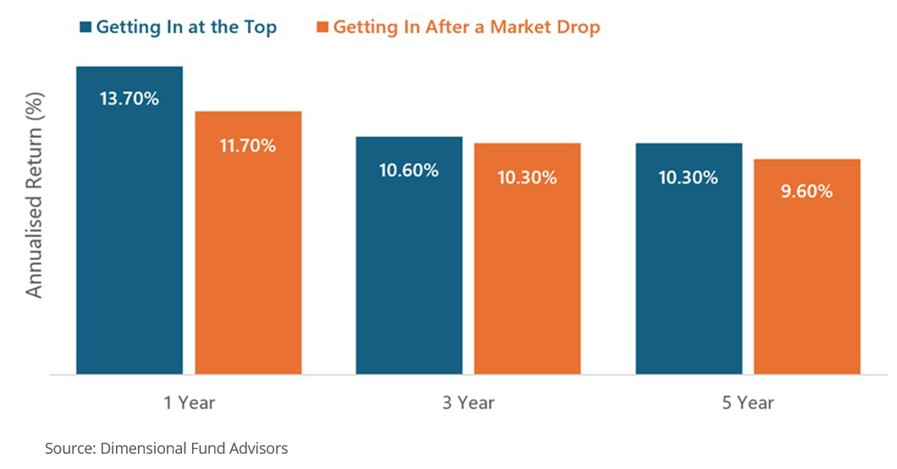
While individual cases may vary, the graph shows that generally getting in, even if it is ‘at the top’, performs better on average compared to waiting for a 10% market drop.
Those results seem counterintuitive until you think about the nature of market returns. Markets, on average, go up. If today is an all-time high (i.e. ‘the top’) it doesn’t mean the markets will go down tomorrow. It’s more likely that markets go up to a new all-time high tomorrow, and the next day, and the day after that. Simply put, the data showed it was better to invest immediately,
rather than delay.
The real problem is human behaviour
Encouraging clients to invest at all-time highs can be challenging, especially if the news headlines seem to be telling a different story. Unfortunately, the news cycle is designed to shock, more than inform, and relying on headlines isn’t a reliable basis for making investment decisions.
To illustrate this, the following list of headlines from New Zealand news outlets demonstrates how forecasts, even those provided by supposed experts, can be unreliable.
Selected headlines and NZX 50 Index returns
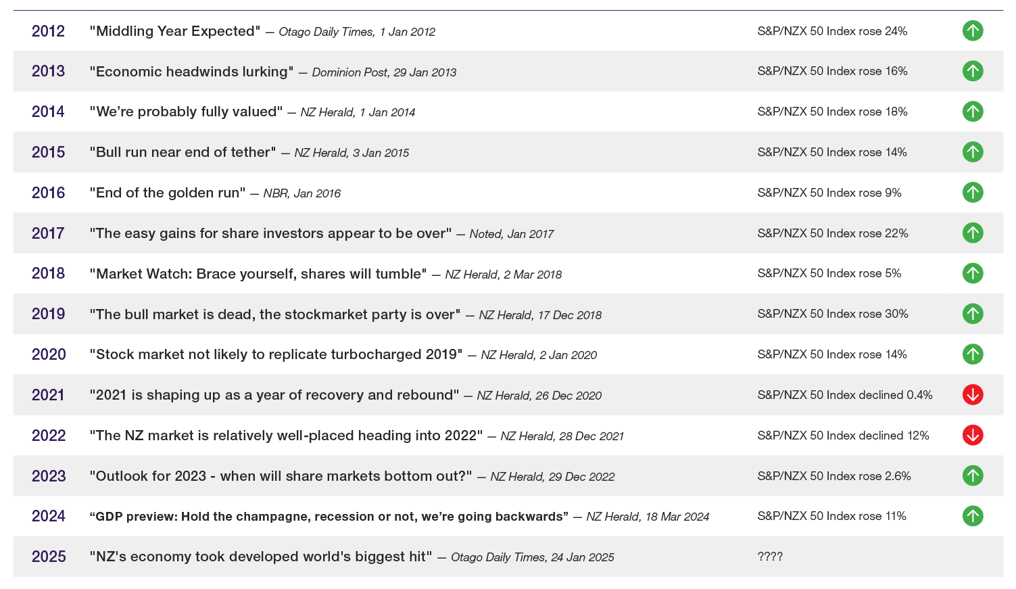
Investors who think market returns are predictable, beyond the general long-term upward trend, often sit on the sidelines waiting for a correction that might not come for months or even years. Meanwhile, the market might climb, for example, 15% while they wait. Frustrated by missing out on those gains, the stalled investors become even more hesitant to buy. When the market finally does decline, the economic news is inevitably grim, so they decide to wait longer, hoping for an even steeper drop. But then the market rebounds, and they miss their opportunity altogether.
While markets are unpredictable, this behaviour is entirely predictable, and it's the behavioural pattern advisers strive to help investors avoid.
Why advisers often say “invest now”
When advisers recommend investing “now”, it’s not because they know for certain that “now is the perfect time to invest”. It’s because they understand that once someone falls into the trap of trying to forecast the market, they are far more likely to achieve worse results than if they simply invested whenever they had extra money and withdrew only when they needed money, without attempting to time the market at all.
If an investor needs money in the short term, advisers will not recommend a portfolio heavily focused on investments that are prone to significant short term price drops. But for long-term investors, price fluctuations over the next year or so are unlikely to matter much in the grand scheme of things.
There has never been a ‘bad’ 30-year starting point
One of the most powerful illustrations of long-term investing comes from every 30-year return (measured from month-end prices) delivered by the S&P 500 Index since World War II.
S&P 500 rolling 30-year returns
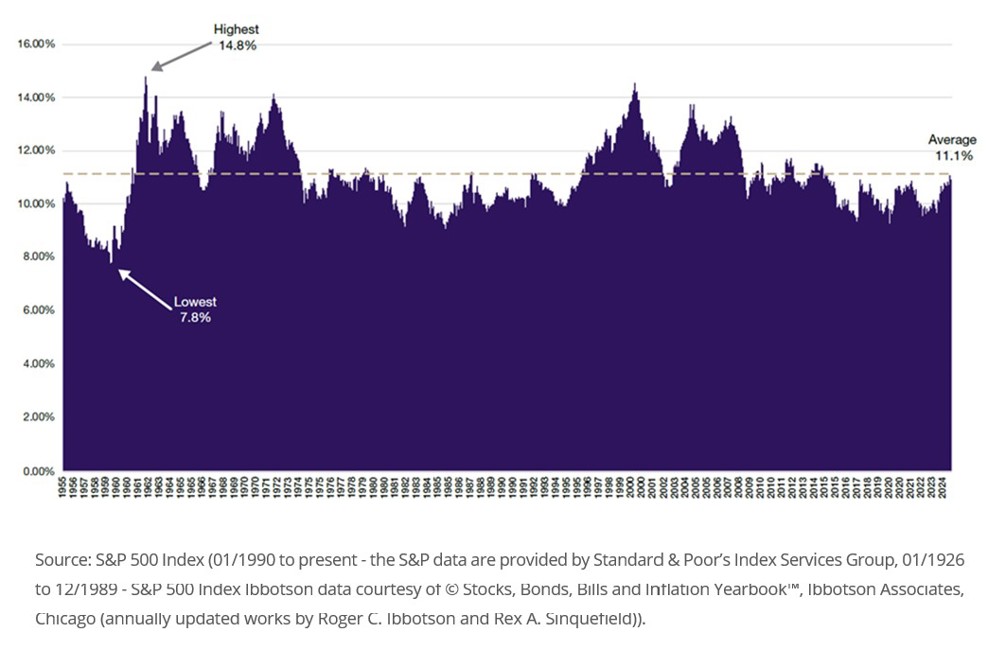
A 30-year horizon is a typical retirement planning horizon for someone starting retirement at NZ Superannuation age (currently 65).
The takeaway from the graphic is clear: over a 30-year period, there has never been a bad time to start investing. Even if you had started right before the Great Depression, you would have still achieved a long-term investment return of almost 8% (before tax and fees), though the journey would have been undeniably volatile.
Past performance never guarantees future outcomes, but history consistently reinforces one key lesson – long-term discipline is rewarded.
So, is now the right time to invest?
For most long-term investors, the answer is simple:
Yes – because waiting for the ‘perfect’ moment usually leads to poorer outcomes.
No one can consistently predict market corrections, and fortunately, long-term investors don’t need to. In fact, history shows that even at market highs, it’s usually more beneficial to invest immediately rather than waiting for a potential downturn. What matters is avoiding the temptation to predict short term price movements or base decisions on popular economic forecasts. Instead, focus on sticking to a well-designed investment plan that aligns with your goals and time horizon.
It was the famous American investor Peter Lynch who put it so accurately,
"Far more money has been lost by investors preparing for corrections, or trying to anticipate corrections, than has been lost in corrections themselves."
This article is provided for your information only. It does not constitute financial advice and has been prepared without taking into account any personal financial circumstances.