
Investing like it's 1996
You are an investor with a long-term investment horizon. What if I could tell you that the next 30 years would contain:
A significant currency crisis
At least one global pandemic, and several other major global health threats
A global financial crisis
Several new wars and scores of significant armed conflicts
An escalation in global terrorism events
Economic trade wars
If crystal balls worked, that’s what we would have been able to tell an investor in 1996. So, what should they have done with that information? Hint: The answer is not to ask the crystal ball what the best investment would be! For this thought experiment to work, a crystal ball can only inform about major news events, not provide insights into financial market returns.
Knowing with certainty that those big nasty global events lay in wait, how might a thoughtful investor have incorporated that information into their 30-year investment strategy in 1996?
Back then, the world was beginning to embrace this new thing called “the internet”. Investment markets were buzzing. There was no shortage of hype and no shortage of investment options.
But due to our crystal ball, we also know things about the future that suggest that maybe we should proceed with caution.
So, we came up with a range of options an investor might have considered:
Buy a safe and stash all their spare cash there
Hold rolling six-month term deposits at major New Zealand banks
Buy diversified global bonds (Bloomberg Global Aggregate Bond Index, NZD)
Buy a house (RBNZ House Price Index)
Buy a highly diversified, balanced risk investment portfolio (50% growth assets)
Buy a highly diversified, high risk investment portfolio (98% growth assets)
Note, some of the potential options available to investors today, such as buying cryptocurrencies, weren’t available in 1996 so the above list focuses on some of the more common options that were available.
How do we think the above strategies might have performed?
We assumed an investment amount of $100,000 on 1 January 1996 and an eventual end date of 31 December 2025 (for a full 30-year analysis period). Where appropriate, we also deducted estimated fees applicable to each strategy and made further adjustments for personal taxes (based on an assumed tax rate of 28%) so that each scenario reflected a net return outcome. See the sources and return assumptions summarised at the end of the article for more detail.
The purpose of this analysis is not to produce a perfectly investable real-world scenario, but to illustrate how different investment approaches have tended to behave over long periods of time.
The 30-year results were as follows:
Cash in a safe
Not surprisingly, when we reopened the safe at the end of 2025, there was still $100,000 in there. But that’s where the good news ends. It turns out that $100,000 in 2026 buys a lot less than $100,000 could purchase in 1996, about half as much, in fact. New Zealand inflation over the last 30 years worked out to be a touch above 100%, meaning prices broadly doubled since 1996. In real (inflation-adjusted) terms, that $100,000 in 1996 turned into about $50,000 worth of purchasing power in 2026. So, your money may have been ‘safe’, but it also lost a lot of value.
End value, December 2025 = $100,000.
Rolling six-month term deposits
This option provided a ‘no surprises’ return. Investing in term deposits returned more than inflation, but this ‘low risk, low return’ strategy was never going to deliver significant upside. However, it did manage to return more than inflation, at least protecting your purchasing power.
End value, December 2025 = $286,232.
Global government and corporate bonds
The Bloomberg Global Aggregate Bond Index (hedged to NZD) rewards investors in two ways – it takes more ‘duration risk’ than 6-month term deposits and generally also takes more ‘credit risk’ by loaning money to international governments and large corporates. As a result, a diversified exposure to global bonds delivered almost 25% more than a rolling term deposit strategy.
End value, December 2025 = $353,929.
An ‘average’ house
Due to the idiosyncratic nature of property returns, we were tempted to exclude this from the analysis entirely, because a ‘generic’ calculation won’t ever capture the returns of an individual property. However, as property ownership is so heavily ingrained in the New Zealand psyche, we felt we should at least look at average house price movements over the last 30 years, less an estimate of rates and insurance costs. For simplicity, other costs such as transaction costs, legal fees, repairs and maintenance and debt servicing, have all been ignored, and so too has the potential after tax return from any rental income. The house price index data published by the Reserve Bank, implies an ‘average’ compound price gain (after deducting rates and insurance only) of around 4.8%p.a.
End value, December 2025 = $409,481.
A balanced diversified portfolio (50% growth/50% fixed income)
A balanced-risk portfolio targeting an equal allocation to lower risk fixed income assets and higher risk growth assets performed the second best in this analysis. We used actual and back-tested portfolio returns and compounded these returns on a net of all costs and fees basis. Not only did the balanced-risk portfolio achieve a slightly higher return than the theoretical ‘average house’ price gain, it was also less volatile while remaining fully liquid at all times. A balanced portfolio delivered a compound net return (after all assumed fees and taxes) of around 5.3%p.a.
End value, December 2025 = $469,108.
A high growth diversified portfolio (98% growth/2% cash)
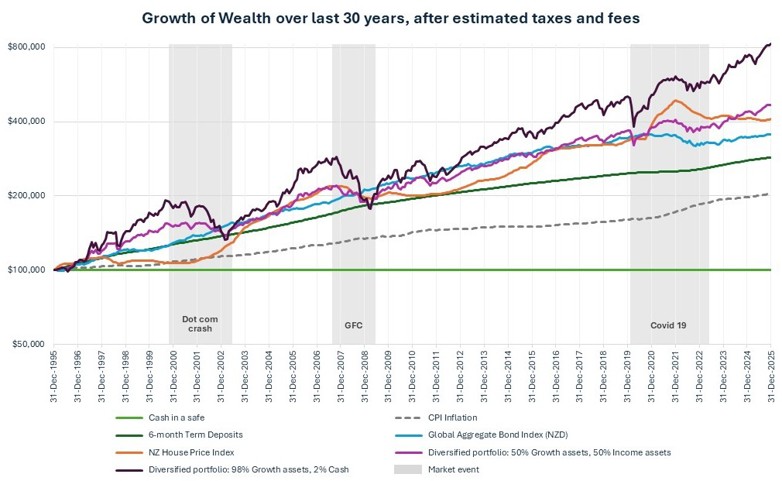
A high-risk portfolio targeting higher risk growth assets only, delivered easily the best result of all the scenarios tested. Growth assets typically experienced heightened volatility when markets were under stress (i.e. during the dot.com crash in the early 2000’s, the Global Financial Crisis from 2007 to 2009, and the 2019 to 2023 period impacted by Covid-19). However, through all of these, and other market upheavals, good quality growth assets remained liquid and outperformed the other investment options by a margin, delivering a compound net return (after all assumed fees and taxes) of around 7.3%p.a.
End value, December 2025 = $828,759.
While the end values highlighted above represent the outcome at the end of December 2025, the graph below shows the 30 year ‘growth of wealth’ journey of each of the strategies over time.
What can we take from all this?
The major conclusion is… even if we know in advance that a series of ‘bad events’ are going to happen over the next 30 years, it is still likely that the best thing we can do is build a diversified investment strategy and take as much investment risk that we can tolerate and stick with over time.
As significant as many of those highlighted events were over the last 30 years – and the dot.com crash, the Global Financial Crisis and the Covid crash all had a material impact on investment markets when they occurred – good quality risky assets delivered a great outcome for investors who stayed patient.
This is a testament to the importance of a long-term investment horizon, the power of compounding investment returns, and investors sticking to their plan.
It is also a good reminder that the biggest threat to long-term returns is often not market volatility itself, but investor behaviour during periods of volatility.
When a new investor joins KiwiSaver today, they have the longest potential investment horizon they will ever have. For these investors (and many others with still very long investment horizons ahead of them), taking a significant exposure to higher risk assets is often going to lead to better financial outcomes over the very long term.
Of course, not all growth strategies are created equally, so seeking guidance from an independent financial adviser who can assist you with strategy selection and investment management and monitoring is also likely to add considerable value.
This is particularly the case when investment balances get large enough (through compounding investment returns and ongoing regular savings) to become a source of additional emotional strain on non-expert investors.
For many investors, the value of advice is not just recommending an investment portfolio, it’s having a trusted expert who can help keep emotions out of decision making when markets become uncertain.
History tells us that when market conditions get challenging, unadvised individuals are more likely to succumb to behavioural impulses that will ultimately lead to worse outcomes.
However, with an adviser to call on, investors are much better equipped to ignore short term market noise, and focus instead on the things they can control, like family, relationships and maintaining a sensible savings strategy.
These are the foundation stones of a successful long term investment strategy.
Because if the last 30 years have taught us anything, it’s that markets have a remarkable ability to reward investors that are willing to take risk, and stay patient, in the face of considerable uncertainty.
This article is provided for your information only. It does not constitute financial advice and has been prepared without taking into account any personal financial circumstances.
Sources and return assumptions
Inflation – sourced from www.rbnz/govt.nz/statistics (prices - M1)
6-month term deposit rates – sourced from www.rbnz/govt.nz/statistics (retail interest rates on lending and deposits). Tax applied @ 28% on monthly returns.
Global aggregate bond index (using Lehman Brothers Global Aggregate Bond Index USD hedged returns from Jan 1996 to Jan 1999, Lehman Brothers Global Aggregate Bond Index NZD hedged returns from Feb 1999 to Oct 2008 and Barclays Global Aggregate Bond NZD hedged returns from Nov 2008 onwards) – sourced from DFA Returns Web. Tax applied @ 28% on monthly returns.
NZ House Price Index – sourced from www.rbnz/govt.nz/statistics (housing - M10). As there is no assumed income, there has been no tax applied. As noted in the article, no other assumed running and management costs have been applied either. The only costs applied have been rates and insurance assumed at a combined 1.0% p.a. based on prevailing house value. These costs can vary widely from region to region.
Diversified portfolio (50/50) – sourced from Consilium returns database, based on Consilium Classic 50/50 model allocation (live returns from 2010 to 2025, back-tested returns from 1996 – 2009). Returns are net of fund manager fees, estimated adviser fees, custodial fees and tax. Adviser and custodial fees have been included at 1.00% p.a. net (i.e. recognising the tax deductibility of adviser/monitoring fees). Tax on growth assets was applied at an average of 1.00% p.a. based on Consilium expected returns data, and tax on income assets was applied @ 28% on monthly returns.
Diversified portfolio (98/2) – sourced from Consilium returns database, based on Consilium Classic 98/2 model allocation (live returns from 2015 to 2025, back-tested returns from 1996 – 2014). Returns are net of fund manager fees, estimated adviser fees, custodial fees and tax. Adviser and custodial fees have been included at 1.00% p.a. net (i.e. recognising the tax deductibility of adviser/monitoring fees). Tax on growth assets was applied at an average of 1.00% p.a. based on Consilium expected returns data.